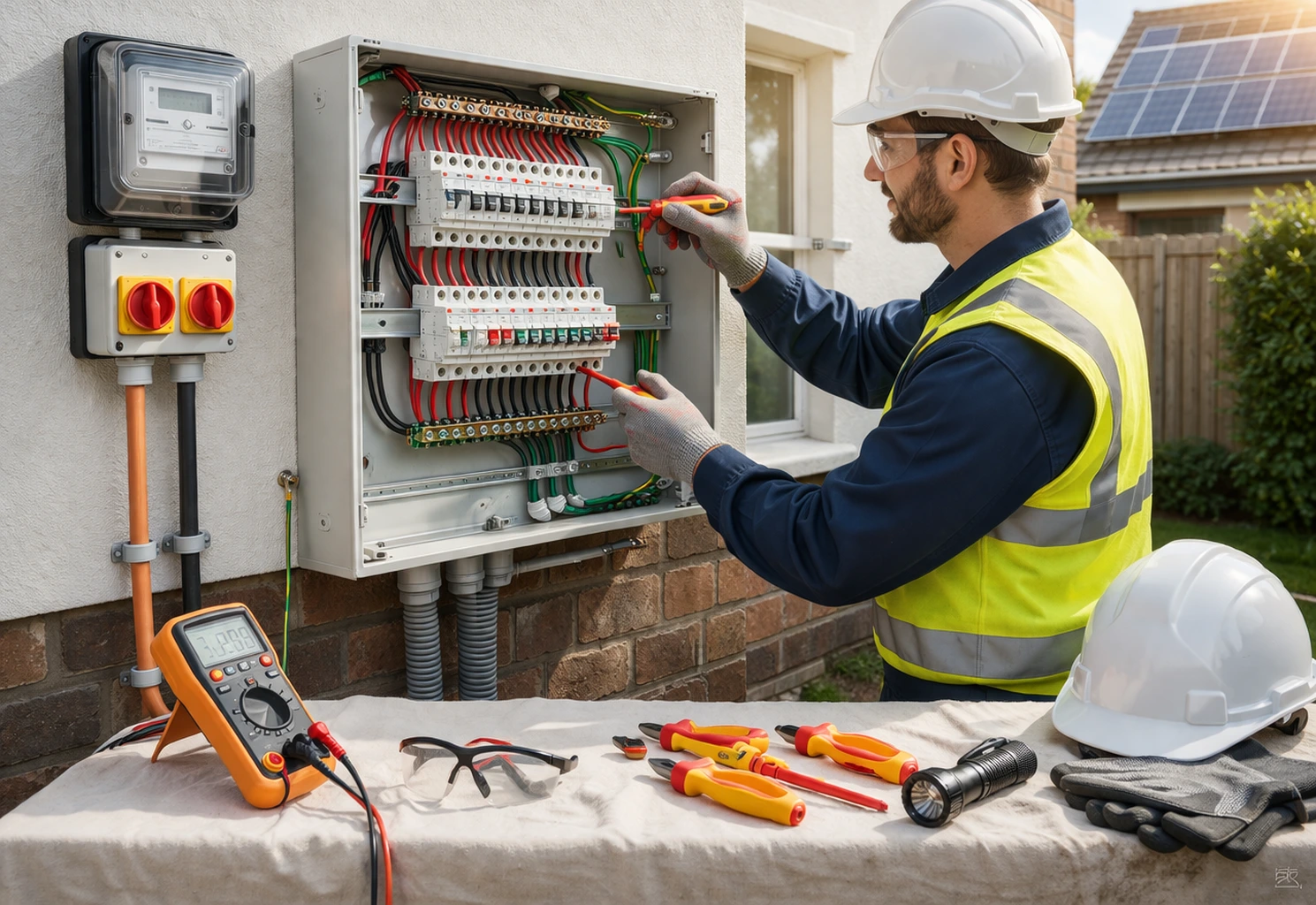
A modern electrical system starts with a safe and reliable switchboard, and this is exactly where a switchboard upgrade electrician plays a critical role. They improve power safety by replacing outdated fuse boxes with advanced switchboards that use circuit breakers and safety switches.
Unlike old ceramic fuses that can fail silently, modern systems quickly detect faults and cut off electricity before it becomes dangerous. This simple upgrade reduces the risk of electric shocks, appliance damage, and even house fires.
An experienced switchboard upgrade electrician also ensures your home meets current Australian safety standards, especially in areas like Frankston where energy use has grown with modern lifestyles.
With more appliances, air conditioning systems, and home offices in use, older switchboards often struggle to handle the load. Through services like switchboard replacement, main switchboard installation, and RCC safety switch installation, electricians create a system that distributes power safely and efficiently.
In practical terms, this means fewer unexpected power trips, better protection for your family, and a home that can handle today’s electrical demands without risk. Upgrading your switchboard is not just a technical improvement—it’s a smart safety decision that protects both your property and peace of mind.
When Old Switchboards Become Fire Hazards
Old switchboards hide real dangers. Imagine trying to run your gaming PC, aircon, and kitchen appliances all at once – if the panel trips off or you catch a whiff of scorched plastic, your switchboard is crying out for help.
Common warning signs include frequent blown fuses or tripping circuits, burning smells, flickering lights or scorch marks near the panel. These red flags mean the system is overloaded or wired improperly. Ignoring them can literally set your home alight (electrical fires are a leading cause of house fires) or give someone a nasty shock.
In fact, Australian safety experts warn that RCD safety switches (the lifesaving devices that instantly cut power during faults) are “the single most effective measure to prevent electrocution, serious electrical injury and electrical fire”. In short, an antique switchboard without those modern safety bits is a recipe for trouble.
I remember chatting with a Frankston electrician once who said he’s seen blackened fuse boxes after hot summers – overheated wires, melted insulation – “It’s like a bomb waiting to go off,” he joked. That friendly sparky explained that today’s homes draw far more power than decades-old wiring was designed for. Renovations and gadgets pile on the load. In Frankston’s energy-hungry households, an outdated board is practically a time bomb.
The Switchboard Upgrade Electrician: Your Safety Sidekick
Who is a switchboard upgrade electrician and why do you need one? Think of them as licensed ninjas of the electrical world – specially trained to dismantle dangerous old systems and build new, code-compliant ones.
In Victoria (and all of Australia), only licensed electricians can legally touch the switchboard. They know the ins and outs of regulations from Energy Safe Victoria and the Australian/New Zealand Wiring Rules (AS/NZS 3000). For instance, Victorian law now says any “residential-type main switchboard” replacement is high-risk and must stay powered off until an independent inspector signs it off.
In plain English: you must use a pro who follows these rules. You can also review the Victorian electrical safety guidelines to understand the latest compliance requirements for modern switchboards.
When you call in the pros, they don’t just slap on new breakers. They thoroughly inspect and test everything. They’ll check that every cable is correctly sized and protected, and that circuits are clearly labeled (no more guessing which breaker does what).
They also ensure the board has enough spare spaces for future expansion – say you want to add an EV charger or solar panels, they’ll have planned ahead. As one Melbourne electrician put it, upgrading your switchboard “dumps outdated, unsafe systems” and moves you into a “future-ready switchboard” without the stress. Essentially, the upgrade electrician is your safety manager: following strict codes, installing best-practice equipment, and certifying the job so you can rest easy.
What a pro electrician does in an upgrade:
- Licensed work:
Follows AS/NZS 3000:2018 and local Vic codes (Energy Safe Victoria guidelines). - Remove old gear:
Safely de-energises and removes that old fuse box or faulty breakers. - Inspect wiring:
Examines all existing wires for damage and replaces any unsafe cables. - Install new switchboard:
Fits a modern enclosure with proper gaps and slots. - Add RCDs/Safety Switches:
Installs RCD safety switches on all circuits (required by Vic law). - Reconnect & test:
Attaches each circuit, labels them, then rigorously tests each device and switch.
By doing all this, your electrician turns a dusty old panel into a fortress of safety.
Key Safety Upgrades and Components
Modern switchboards are packed with clever devices that vastly improve safety:
- RCD Safety Switches (Residual Current Devices):
These are the game-changers. An RCD constantly monitors the electricity flow and instantly trips if it detects a leakage to earth (even a tiny one).
The electricity needed to cause fatal shock is much lower than what would blow a fuse, so only an RCD catches it in time. Imagine a circuit trying to flow through your body – an RCD detects even milli-amps of leakage and flips the switch in milliseconds, saving lives.
Australian regulations now force RCDs on all power and lighting circuits during new builds or upgrades. A switchboard upgrade electrician will make sure at least two RCDs cover the whole home (the bare minimum under safety codes), and may even install more RCDs (or the more advanced RCBOs) to protect individual circuits like kitchens, bathrooms, or outdoor outlets. Testing them every 3 months (press the “T” button) is part of good maintenance. - Circuit Breakers instead of Fuses:
Gone are the days of ceramic screw-in fuses. Breakers provide more precise protection and are easily resettable. A tripped breaker (often connected to a safety switch) means it cut the power off safely, whereas a blown fuse had to be replaced each time.
The electrician installs modern breakers sized correctly for each circuit, preventing overloads. If any components are near end-of-life or outdated, they’re swapped out. - Surge Protectors & Spark-Free Terminals:
Some upgrade electricians will add surge protection devices in the switchboard, protecting expensive electronics from lightning or grid surges. They’ll also use secure terminals (so wires can’t come loose). These tweaks reduce fire risk and malfunctions down the track. - Labeling and Segregation:
Every new board should have clear labels (e.g., “kitchen lights”, “aircon”, etc.) and separate cables neatly. An expert will ensure neutral and earth wires are grouped properly. This means future maintenance is safer, and in an emergency you know exactly which switch to hit.
Main Switchboard Installation: Future-Proof Power Hub
Sometimes an upgrade isn’t enough and a full main switchboard installation is needed – say you’ve done a big renovation, built an extension, or are wiring a new home. Here, the electrician essentially builds the power heart from scratch.
They install a robust main switchboard (often outdoors or in a meter box) that handles the incoming supply. This setup includes a heavy-duty main switch (big breaker) and space for sub-boards. According to industry pros, a reliable main switchboard is “the backbone of your electrical system” and key to preventing overloads and outages. It’s where the incoming street power arrives and then gets divided to your house circuits.
For example, if you add solar panels or plan a large workshop, the electrician will gauge the power needs and install a main switchboard that can cope. They’ll set it up with surge diverters, and in commercial settings, multi-phase support if needed.
This means your home is not just safe for now, but ready for tomorrow’s gadgets. After the new main switchboard is installed, the sparky will certify it so everything is up to code.
The Upgrade Process Step-by-Step
To demystify it, here’s roughly what happens during a professional switchboard upgrade:
- Safety First:
The power is turned off at the meter. The electrician arranges a Licensed Electrical Inspector to attend (Victoria requires this for switchboard replacements before power is reconnected). - Strip Out Old Board:
The old panel (and any asbestos backing if present) is safely removed. All old fuses, breakers and wiring in the board are lifted out. - Inspect & Label Wiring:
Each live, neutral, and earth wire is carefully inspected. The electrician renumbers or labels the wires as they come out, so nothing gets lost. Any degraded cables are replaced. - Install New Enclosure:
A new switchboard enclosure (often metal for earth grounding) is mounted. Inside, new railings and backplates go in. - Fit Breakers & RCDs:
Modern circuit breakers and RCD safety switches are fitted into the slots. For example, an electrician might install one RCD for all lighting circuits and another for power, or individual RCBOs per room. Each breaker is calibrated to the right amp rating. - Reconnect Circuits:
The electrician methodically connects each labelled wire to the appropriate breaker or RCD. They also connect an earth block for safety. It’s a bit like puzzle-solving, but done with precision. - Testing & Commissioning:
Before closing the panel up, they test every circuit with meters and a test button on the RCDs. Only after everything passes, the panel door goes on. - Certificate & Handover:
The job is certified with an Electrical Safety Certificate. The electrician explains any changes (pointing out the new switch tests, etc.) and hands over documentation.
It’s not a DIY job – there’s too much at stake. But seeing those new RCDs and breakers installed is like witnessing a high-tech armor being fitted on your home.
Keeping in Line with Victorian Law
In Victoria (which includes Frankston), there are strict rules around switchboard work. Recent legislation under the Residential Tenancies Regulations 2021 (effective March 2023) now requires all rental properties to have safety switches installed on power and lighting circuits. Even if you own your home, this shows the direction: safety switches (RCDs) must be standard.
Moreover, the Electricity Safety Act 1998 mandates that only licensed electricians can perform switchboard work, and replacements must stay de-energised until an inspector signs off. That means your sparky must liaise with an independent inspector and cannot simply flick the mains on and disappear. The fines for non-compliance are hefty (thousands of dollars for breaches), so professionals take it very seriously.
Also, Australian Standards (AS/NZS 3000 and 61439) require upgrades to use quality components and proper installation methods. In short, a licensed switchboard electrician doesn’t just do the physical work – they ensure legal compliance and offer the insurance companies the documents they might need if there’s ever a claim. This authority means when the electrician leaves, you can trust the job was done safely and by the book.
Benefits: Safety, Reliability, and Peace of Mind
So after all this, what do you get? Quite a lot:
- Greater Protection:
With modern circuit breakers and RCDs in place, your home is much safer. There’s a big difference between an old fuse that might fail silently and an RCD that trips and saves lives. - No More Nuisance Trips:
Properly sized breakers mean circuits trip only when really needed. No more fried fuses every time you run the aircon and microwave together – the electrician will balance the load. - Future Expansion:
You’ll have room to add new circuits (hello, home gym or EV charger!) without rewiring the whole house. - Insurance and Compliance:
A fully upgraded switchboard with compliant gear can prevent insurance issues. If a fire ever occurred, you’ll be more likely to be covered, since you followed safety rules. Real estate pros also note a compliant switchboard is a selling point. - Long-Term Peace of Mind:
Simply knowing a pro has inspected, upgraded, and certified your electrical system means you can sleep easier. No more guessing games about the state of your wires.
Conclusion
In a nutshell, a switchboard upgrade electrician is like a safety guru for your home’s power system. They swap out dodgy old components for up-to-date breakers and life-saving RCDs, follow the latest Victorian regulations, and ensure the entire system is wired correctly.
You, the homeowner in Frankston, end up with a robust, future-proof setup that guards against shocks and fires. Think of it as investing in home insurance you can test – with that friendly sparky’s certificate in hand, you’ll know your family and gadgets are protected.
Ready to give your switchboard a health check? Call a licensed Frankston electrician – they’ll guide you through the process and connect your home to safety. Trust me, a little prevention now is a bright idea for years of hassle-free power.
FAQs
1.What exactly is a switchboard upgrade electrician?
It’s simply a licensed electrician who specializes in replacing or modernizing your home’s electrical switchboard (fuse box). They handle everything from removing old fuses to installing new circuit breakers, safety (RCD) switches, and wiring to current standards.
2.How does an RCC safety switch work?
“RCC” refers to safety switches like RCDs (Residual Current Devices). These are monitors inside your switchboard that instantly cut off power if electricity is leaking to earth (for example, through a person or a faulty appliance). They trip in milliseconds, protecting you from electrocution and fire.
3.Why should I consider a switchboard replacement?
If your board is vintage (think ceramic fuses), you’ve had electrical defects noted, or you’re constantly blowing fuses or seeing odd symptoms, you need one. Upgrading ensures modern overload protection, keeps you legal with Vic regulations, and dramatically lowers fire/shock risks.
4.What is involved in a main switchboard installation?
This is a bigger job – usually for new homes or major extensions. It means installing the main distribution board where the power supply comes in. It involves a strong main switch, space for circuits, and the same safety devices (RCDs, breakers). A pro ensures it’s built to handle your needs safely.
5.When should I test my safety switches (RCDs)?
Test them every 3 months by pressing the “T” (test) button on each safety switch. If the switch doesn’t trip instantly, you should have the electrician check it. Regular testing confirms they’ll work in an emergency.
6.Are safety switch installations mandatory in Frankston/Victoria?
Yes. Victoria now requires safety switches on all rental property circuits as of 2023, and effectively on all homes via electrical code updates. During a switchboard upgrade, your electrician will install them on every required circuit to comply with these laws.